
Who answers your eye practice website at nine at night?
Patients read about cataract surgery and myopia management late at night, long after your team has gone home. Why website visitors leave without getting in touch, and how OmniConcierge can answer them on chat, voice and even enable real-time on website video calls.
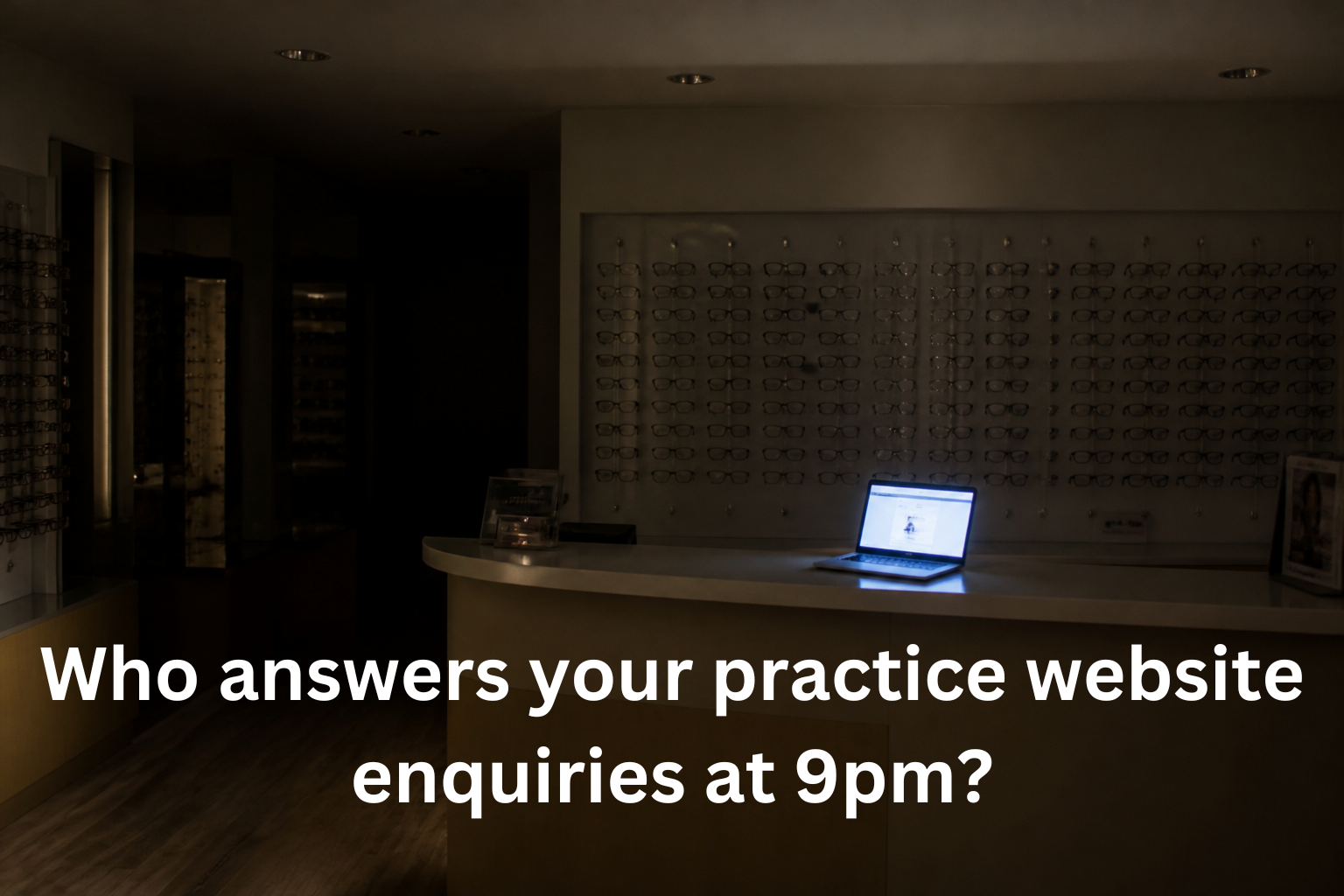
Who answers your eye practice website at nine at night?
By Dr Kuki Hundal, founder of Omni A-Eye
The short answer: for most practices, a contact form. Your website is open around the clock. The people who answer patients' questions, the private secretary in an ophthalmology clinic and the reception team in an optometry practice, work office hours. OmniConcierge staffs the website 24/7 on chat, voice and video (when manned). It answers from your approved information, books appointments and callbacks, and hands over to your team (during opening hours) whenever a person is needed.
Why do website visitors leave without getting in touch?
Your website is the only member of staff who never takes a day off. And most practices have given it a clipboard.
That clipboard is the contact form. It has all the warmth of a parking ticket, and it works office hours too, in its own way: it takes a message and waits for somebody to come in on Monday.
Think about who's reading your site in the evening. In a private ophthalmology clinic, it's someone weighing up cataract surgery, back on the same page for the third time this week. In an optometry practice, it's a parent reading about myopia management, or someone wondering whether your dry eye clinic is worth the drive.
They have questions. How long is the wait for a consultation? Do you see children? What happens at the first appointment? Can I pay in stages?
And at that hour, who's there to answer? Your private secretary is excellent at the job, and the job already includes the consultant's lists, the insurers and the clinic letters. Your optician's reception team has just got through the five o'clock rush. Both of them have gone home, as they should.
So the visitor fills in the form. Or they don't, and close the tab and look up the next clinic.
What does an unanswered website visitor cost a practice?
You paid for that visit. Perhaps through Google Ads, perhaps through years of building a reputation good enough that someone searched for you by name. Either way, they read the page and left, and you have no idea who they were or what they wanted to ask.
You can't follow up someone who never said hello. And you'll never find out that the person reading your cataract page at twenty to eleven on Tuesday booked a consultation somewhere else on Wednesday morning.
A question asked at eleven at night wants an answer at eleven at night. The reply that goes out at ten the next morning lands after the moment has passed.
In private ophthalmology, where one enquiry can lead to surgery on both eyes, that silence is expensive. In optometry, it might be a myopia management programme that would have looked after a child's eyes for years.
Where do patients get lost between optometry and ophthalmology?
Optometry and ophthalmology get talked about as two separate trades. To a patient, it's one journey. The sight test that spots the cataract, the referral, the consultation, the surgery, then the check-up back with their own optometrist.
I've worked on both sides of that journey, as an optometry practice owner and in clinic and operating theatres as an ophthalmologist. Most of what gets lost, gets lost in the gaps between appointments: the moment somebody has a question and nobody is there to answer it.
Your website is one of those gaps, and it's open all night. That's the gap OmniConcierge was built to close.
What does a website staffed 24/7 look like?
Same visitor, same cataract page, quarter to eleven at night.
After a few minutes on the page, a message appears. It's written for the cataract page, so it talks about cataract consultations, and asks whether they'd like to know anything before booking.
They type a question and get an answer straight away, word for word from your practice's own approved information. They ask about the wait for a consultation and get your current answer. They ask whether a particular lens would suit them, and are told that's a question for the consultant, then offered a consultation or a callback.
If they'd rather talk, they press a button and speak. If they'd like to see a face and someone in your team is available, they can be on a video call with your practice, inside the website, on their phone or laptop. Nobody downloads anything or waits for a meeting link.
By the morning, the consultation is in the diary, and the whole conversation is written up for your team to read.
Swap the cataract page for your myopia management page and the private secretary for your reception team, and it works the same way in an optometry practice.
How do OmniConcierge, OmniEngage and OmniDesk work together?
Three AI workers share one job: making sure nobody who wants your practice leaves without being looked after.
OmniEngage opens the conversation. It looks at how each visitor behaves on your site: the page they're on, how long they've been reading, whether they've been before. When someone shows real interest, it sends a message written for that page, instead of waiting for them to make the first move.
OmniConcierge does the answering, on chat, voice or video, 24 hours a day, from the information you've approved. It books appointments and callbacks, and hands the conversation to your team whenever a person is needed.
OmniDesk looks after the phone. Plenty of people read the website and then ring, and OmniDesk answers those calls day and night. Whichever way a patient gets in touch, they get the same answers.
What can the practice see and control?
Every visitor gets an intent score, worked out from what they do on your site: the pages they read, the time they spend and whether they come back. A high score tells your team who's worth a hello right now.
Your team can also see each visitor's route through the site, page by page, so they know what someone was reading before they got in touch.
Conversations are recorded and transcribed, and visitors are told. Every transcript goes onto the patient's record, so nobody has to write up a note from memory the next morning.
A member of your team can watch a live conversation and step into it at any point. We call that a handover, the same word used when one clinical shift hands over to the next.
You set the rules. Chat, voice and video can each be switched on or off. Each one can run AI only, AI then human, or go straight to a person. If your consultant wants every video call to go to a person, that's how it's set up.
Different pages can have different welcomes. The cataract page can open with a video greeting from your surgeon, and the myopia management page with one from your lead optometrist. If you need more than one concierge, for different services or different sites, you can have them.
What changes for the practice?
The aim is to capture more of the enquiries you're already paying for. People who would have read and left now start a conversation.
Those conversations are more likely to become bookings, because the answer arrives while the person is still interested. The consultation is booked there and then, or the callback is arranged, and your team picks it up with the transcript in front of them.
And patients get access to your practice and its expertise when they need it. That includes the person with a question about surgery at midnight, who would otherwise have to wait until morning to ask.
Where's the clinical line?
OmniConcierge answers from what you've approved, and nothing else. It doesn't diagnose, and it doesn't judge suitability for surgery or how urgent a symptom is. Questions like that are handed over to your team. If somebody describes an emergency, they're told where to get urgent help.
See it on your own website
Before we speak, we build OmniConcierge on a copy of your website, using what's already on it. On the call, open it on your phone. Ask it what your patients ask, and request a video call. Then we'll look at what happens to your website visitors now, using your own figures.
Dr Kuki Hundal Founder, Omni A-Eye
FAQ
Can patients ask about surgery on a clinic's website out of hours? Yes. OmniConcierge answers on chat, voice or video, 24 hours a day, from the information the practice has approved. Questions about whether surgery is right for someone are handed over to the consultant's team, with a consultation or callback offered.
Does a video call from the website need Zoom, Google Meet or an app? No. The video call happens inside the website, on the patient's phone or laptop. There's nothing to download and no link to send.
Will the AI give medical advice? No. It doesn't diagnose, judge suitability for treatment or decide whether a symptom is urgent. Those questions go to your team.
Can we turn video or voice off? Yes. Chat, voice and video can each be switched on or off, and each can run AI only, AI then human, or straight to a person.
What is intent scoring? A score for each website visitor, based on what they do on the site: the pages they read, how long they stay and whether they come back. It tells your team who's worth speaking to now.
Are website conversations recorded? Yes. Conversations are recorded and transcribed, visitors are told, and each transcript is attached to the patient's record.
Can different pages have different greetings? Yes. Each page can have its own message and video greeting, and a practice can run more than one concierge for different services or sites.
Does OmniConcierge work for optometry practices as well as ophthalmology clinics? Yes. It's set up around each practice's own services, team and booking rules, whether that's cataract surgery or myopia management.
What does it cost? We cover that on the demo call, once we've seen your website traffic and worked out which workers you actually need.
Hear an AI Worker Trained on Your Practice
We configure it on your real services before we talk.