
Cataract enquiry - who answers the patient who asked at 7.40pm?
Private cataract enquiries often arrive in the evening, when no one is there to reply. Or, during the day when you and your team are busy. Self-pay demand is at a record high, so here is what a slow reply costs a private eye clinic, and how to answer every enquiry within minutes.
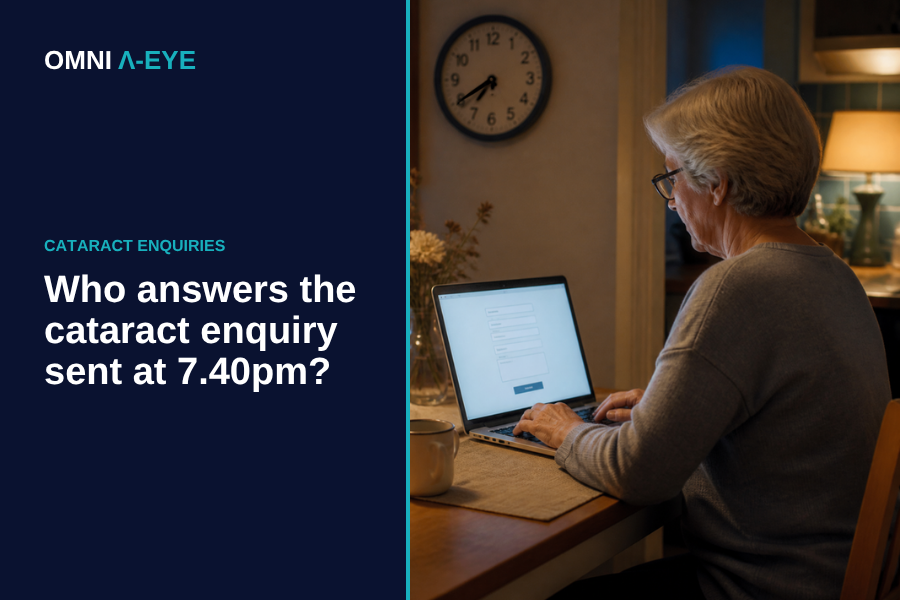
Cataract enquiry follow up: who answers the patient who asked at 7.40pm?
By Dr Kuki Hundal, Founder and CEO, Omni A-Eye
A form arrives on your website at 7.40pm on a Tuesday. A 68-year-old wants to know whether she is suitable for private cataract surgery, roughly what the process involves, and whether she can be seen before her planned holiday. Your patient coordinator reads it at 9.15 the next morning, between two calls and you asking where a biometry printout has gone.
By then, she may have filled in three other forms.
The short answer: in private ophthalmology, the speed of your first response to a cataract or refractive enquiry shapes whether that patient books with you at all. Self-pay demand is at record levels, and the people asking are often comparing several clinics at once. Practices that follow up within minutes, consistently and out of hours, give themselves a fair chance of converting demand they have already paid to generate. Practices that reply "first thing tomorrow" are often replying to someone who has moved on.
Is demand for private cataract surgery still growing?
Yes. According to the Private Healthcare Information Network (PHIN), self-pay admissions to private hospitals reached a record level in the first quarter of 2026. Private cataract admissions rose by 13% to 22,805, and self-pay cataract admissions rose by 21%. Cataract surgery made up 46% of the total increase in self-pay admissions across the UK.
PHIN also notes that patients aged 60 and over accounted for most of the additional self-pay episodes. PHIN's Richard Wells observed that ophthalmology procedures were responsible for much of the self-pay growth, and that it is "definitely worth keeping an eye on." One assumes the pun was intended.
For a private clinic, this is good news with a catch. More people are deciding to pay for their own surgery. They are also deciding who to pay, and that decision often starts with a form, a web chat or a Facebook ad, followed by a wait to hear back.
What actually happens to a private cataract enquiry after it is submitted?
In most clinics, the enquiry lands in a shared inbox or a CRM, and waits for a human to be free. During clinic hours that might be an hour or two. In the evening and at weekends, when many patients and their adult children do their research, it waits until the next working day. Nobody has done anything wrong. The enquiry simply arrived when nobody was there.
Then consider who does the follow-up. In a consultant-led practice, the person calling back new enquiries is usually also:
booking and rearranging existing appointments
chasing insurers for authorisation codes
answering post-operative questions and routing them to the clinical team
preparing consent packs and pre-assessment paperwork
fielding calls from the hospital about theatre lists
New enquiries are important, but they are rarely urgent in the way a patient on the phone with a sticky eye drop question is urgent. So they get done later, in batches, and later has a habit of becoming tomorrow.
Why does response speed matter so much for self-pay patients?
Self-pay cataract and refractive patients are spending their own savings on a decision they care about. Many will research several providers in one evening and enquire with more than one. The first clinic to reply helpfully, with a clear next step, sets the tone. Later replies are often competing with a decision already half made.
There is another cost too. Many private practices pay for their enquiries, through Google Ads, social campaigns, directory listings or referral relationships. An enquiry that receives a reply the following afternoon has still cost the same to generate. It simply has less chance of turning into a consultation.
And speed is not only about the first message. Plenty of enquiries are won or lost on the second and third contact: the patient who said "I need to check with my daughter", or "I'll look at my diary", and then heard nothing more. Consistent, polite follow-up over the next few days is where many clinics quietly lose ground, because it depends on someone remembering to do it during a busy week.
Is it a staffing problem or a process problem?
Mostly a process problem. Patient coordinators in private eye clinics are usually skilled and conscientious. The difficulty is that enquiry follow-up needs to happen instantly and at all hours, while human teams work in shifts and are rightly focused on the patients already booked. Hiring more people helps during the day but does not solve 9pm.
So the useful question is this: what would it take for every new enquiry to receive a fast, accurate, friendly response, regardless of when it arrived, without asking your team to work evenings?
How can a private eye clinic respond to every enquiry within minutes?
By giving first response and early follow-up to a specialist AI worker that acts on your behalf the moment an enquiry arrives. It contacts the patient within minutes, answers operational questions from your approved information, offers consultation times, and hands warm, qualified conversations to your team. Clinical questions always go to a clinician.
At Omni A-Eye, this worker is called OmniGrow, our AI speed-to-lead worker. When a cataract, RLE or refractive enquiry comes in from your website, an ad or a landing page, OmniGrow responds straight away by SMS or email, in your clinic's voice. It can:
acknowledge the enquiry and confirm what the patient asked about
explain, in plain terms and from your own approved content, what the consultation process involves
offer available consultation slots and book directly into your calendar
follow up politely over the following days if the patient goes quiet
log every conversation so your coordinator can see exactly where each enquiry stands
What it does not do matters just as much. OmniGrow does not assess suitability for surgery, discuss lens choices in a clinical sense, interpret symptoms or offer opinions on outcomes. If a patient asks whether their particular eyes are suitable for a premium IOL, or mentions sudden changes in vision, that conversation is escalated to your team. Clinical judgement stays with clinicians. The worker handles the operational part, so your clinicians and coordinators spend their time on the conversations that need them.
This is human plus AI. Your coordinator still builds the relationship, handles the nuanced questions about funding and timing, and welcomes the patient on the day. OmniGrow simply makes sure nobody waits overnight to hear that you exist.
Having spent a long career in eye clinics, I would add one practical observation: patients rarely complain about a reply being too quick. They do notice when it is slow.
Key takeaways
PHIN data shows self-pay private admissions hit a record level in Q1 2026, with cataract surgery driving much of the growth.
Self-pay patients often research and enquire with several clinics, so the first helpful reply carries real weight.
Most slow follow-up is a process problem: enquiries arrive in the evenings and at weekends, when your team is rightly off duty.
An AI speed-to-lead worker can respond within minutes, book consultations and follow up, while escalating all clinical questions to humans.
Your team stays central. The worker protects the enquiries you have already paid for.
Frequently asked questions
How quickly should a private eye clinic respond to a cataract enquiry? As quickly as possible, ideally within minutes. Self-pay patients often contact several providers at once, and the first clear, helpful reply has a better chance of securing the consultation.
Will patients mind talking to an AI worker? Most patients want a quick, accurate answer and an easy way to book. OmniGrow is transparent, writes in your clinic's voice and hands over to a human whenever the patient wants or the question needs it.
Can OmniGrow answer clinical questions about cataract or lens surgery? No. It handles operational matters such as booking, process and logistics, using your approved information. Any clinical question, including suitability or symptoms, is escalated to your clinical team.
Does it work with enquiries from paid ads and landing pages? Yes. OmniGrow can respond to enquiries from your website forms, ad campaigns and landing pages, so leads you have paid for receive a prompt reply.
What happens when a patient stops replying? OmniGrow follows up politely over the following days. If the patient remains quiet, the enquiry can pass to OmniCloser for later outbound conversion or to your team.
Is OmniGrow available now? Yes. OmniGrow and all eight Omni A-Eye workers are live and deployable today.
Hear an AI Worker Trained on Your Practice
We configure it on your real services before we talk.